They call this a garden but there’s no flowers here, just a dusty brown patch of grass surrounded by a high wall and an even higher fence. I’m standing with my guitar in the only square foot of shade. Staff stand and watch. I’ve been given an alarm.

I’m singing my song ‘Keep Walking’ and facing me, bouncing from foot to foot is a patient, rapping. And he’s brilliant.   Other patients surround us, calling out song names ‘do you know this, do you know this’. Everyone wants to sing. This is the intensive care unit at Callington Road Hospital in Bristol.

A care worker appears from the other side of the fence. He and two other workers are supervising one patient. He is built like a brick shithouse with the voice of an angel. We sing ‘One Love’ together, the patients silently listening.

I say goodbye and follow the staff over to the women’s unit. There is the same bare backyard, no trees, no flowers. One woman sits on a bench in a daze, raw patches on her head where the hair came out. She tells me she’d been institutionalised for 18 years and when they finally let her out she couldn’t cope.

Another patient tries to sing to me and then wanders off to sit on the ground and cry. I play another song, terrified that every word and every note is causing her pain. But she looked so much brighter afterwards, says my friend Kirsty, like she needed it.

We go back to the garden with flowers and sit with the patients who are allowed to come off the wards. They’ve been drumming, and eating ice-cream. The air is hot and drowsy. Everyone’s relaxed, sitting in the sunshine. This is as close as you get to happiness in a mental health hospital.

I sing ‘Back Home’ and another Bob Marley song.   Then ‘Start Over Again’, looking round at the faces of these people who have seen and suffered so much. I stand under the banner and smile for the camera. The NHS is 70 today. We have so much to be grateful for.

And then we leave, back out into the real world.


Emily performed at the annual Co-Production Festival in London, part of Co-Production Week organised by the Social Care Institute for Excellence (SCIE).  She sang her songs about surviving mental illness and was applauded by the audience for her speech about the benefits of music for mental health.

“Listening to  was a real treat.  Completely emotive music from this wonderful mental health advocate.” [Care Quality Commission).

To find out more about Emily’s work in mental health, including her hospital gigs, click here.

I’m a passionate believer in the benefits of music for mental health.  Here is an article I wrote after returning to sing my songs at the hospital where I was first sectioned and diagnosed with bipolar disorder:

MUSIC FOR MENTAL HEALTH
Emily Maguire

I’m in the music room at Fulbourn Hospital in Cambridge. Today a group of patients and staff have come to hear me sing my songs. This is the hospital where I was diagnosed with bipolar disorder nearly 20 years ago, where my mum remembers visiting me when I was still high as a kite and I had everyone in the dayroom all playing musical instruments in some crazy jam session.

Coming back to Fulbourn and the scene of a psychosis is surreal and unsettling, and yet this room and the arts therapists who work here are just wonderful. There’s a grand piano, amps, and instruments everywhere. This music room, and the Arts Therapies Service that runs it, is a vital part of the hope and recovery process for those with lived experience of mental health that is provided by Cambridgeshire and Peterborough NHS Foundation Trust (CPFT). Sadly, such provision of arts therapies is increasingly rare in our mental health hospitals.

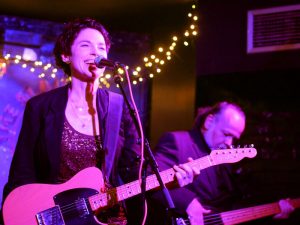
I’m a singer-songwriter now, travelling the country doing gigs. In 2010, I risked my music career to publish a book called ‘Start Over Again’, a highly personal account of my own experiences of living with bipolar disorder, which was launched on Radio 2 on World Mental Health Day. From then on, I started doing gigs in mental health hospitals. I was nervous, not knowing how the patients would react: some of the songs I was singing were pretty close to the bone.

I played on wards where the furniture was weighted down, where handing out CDs to patients was not allowed, where you have to wear an alarm at all times. I never once felt threatened or afraid. These patients were people just like me. I needn’t have worried about the songs: the response was overwhelmingly positive and they were some of the most moving and rewarding gigs I’ve ever done. One nurse commented, “We should have this more often, the effect on the SUs [service users] is amazing.”

I played on intensive care wards, rehab units, wards for people over 65, wards for people living with dementia, adolescent wards, and medium-secure units for young people with serious mental health problems who had been through the criminal justice system. I played for Mind groups, community groups, NHS staff conferences and AGMs. In 2014, I did a tour of mental health facilities for Avon & Wiltshire Mental Health Partnership NHS Trust. Of those 17 places, only 2 had any music provision.

At one of my gigs at a hospital in Bath, I was introduced to one of the patients, a young woman. She looked catatonically depressed and withdrawn, not speaking to anyone. Told that she used to sing in a gospel choir, I got out my guitar, asked her if she knew any Bob Marley and we started singing. We sang ‘Three Little Birds’ and ‘No Woman No Cry’ and by this time she was smiling, looking me right in the eye, and singing her heart out. This didn’t cost the NHS anything.

Music seems to connect to a part of the brain that responds so deeply not even dementia can destroy it. I’ve done gigs in dementia wards where all the patients sang along to ‘Bicycle Built For Two’, knowing every word, despite having no idea of what they’d had for breakfast.

The benefits of music are well-documented: the effect on our brainwaves, the effect on our mood. But we all know for ourselves how beneficial music is; we don’t need scientists to tell us. We play music when we’re happy, when we’re sad, when we’re celebrating, when we’re grieving. Some people can’t think of going anywhere without their headphones on.   If music is so vital for us, fit and healthy in mind, how much more so for people in desperate states of depression and anxiety?

Last year I played in a hospital in north Manchester where they used to have a music therapist, an art therapist and a drama therapist. All gone now. The arts in this context isn’t about entertainment, it’s about recovery. It’s about thousands of people who are suffering a crisis of mental health and need more than just medication and talking therapies to recover their lives.

It’s pretty grim being stuck in a hospital with a lot of very unwell patients, where meals and meds become the focal point of the day. Isn’t that a time when a guitar or other musical instrument as a means for self-expression and as a tool for wellbeing might come in handy? Or even the possibility of communication and emotional connection through song?

Music is an opportunity to learn, to be stimulated, to find a creative way to distract ourselves from our minds, and to express the emotions that sometimes threaten to overwhelm us. All these things would be of benefit to everyone, but most of all to people at the rock bottom of their lives.

I know NHS budgets can only stretch so far. But charitable support can also make a difference; like at Fulbourn Hospital where the Arts Therapies Service is supported by Head to Toe – the NHS charity for CPFT – to enable more musical and arts events that will enhance wellbeing and inspire hope and recovery.

The last time I was sectioned, I was in a hospital in London where they let me keep my guitar on the acute ward. Aside from singing endless Bob Marley songs with the other patients, I wrote a song called ‘Falling On My Feet’. I scrawled the lyrics over and over in my book trying to make sense of them. The song turned out to be a premonition. Four years later, I would stand on my own on stage at the Royal Albert Hall and sing it to 4,000 people.

I write songs about my own experience. I’ve known psychosis, I‘ve known acute clinical depression, I still take anti-psychotics day and night. Patients can relate to what I’m saying. And what I’m saying is, “it is possible to recover, you can come back from this, just look at me”. As one of the patients from the eating disorders unit in Bristol wrote, “Emily didn’t only just give us music but also hope, to show that things can get better. It’s an experience that will stay with me for a long time.”

With every gig I do, whether it’s in a hospital dayroom or a concert hall, my wish is to uplift, comfort and inspire the people listening. Because that is the power of music: it is therapy in its purest form, able to engage and connect with minds that have seen and suffered so much.

For the past six years, my song ‘Keep Walking’ has been used as the anthem for the Defeat Depression campaign in Canada. I would love to see a campaign here in the UK to persuade the Government to spend a small part of their £1.3bn mental health budget on providing music in our schools, our communities and in mental health hospitals. It would be money well spent.

“Music gives a soul to the universe, wings to the mind, flight to the imagination and life to everything.” ― Plato

To find out more about Emily’s work in mental health, please visit.https://emilymaguire.com/music-for-mental-health/

Emily is performing at the annual Co-Production Festival in London next week alongside Britain’s Got Talent winner Lost Voice Guy (aka Lee Ridley), as featured in The Guardian.  Organised by the Social Care Institute for Excellence, the festival is part of the third Co-production Week celebrating the benefits of co-production, sharing good practice and highlighting the contribution of people who use services and carers to developing better social care and health public services.

Thanks to the folks at Crack Magazine for publishing this glowing preview about Emily’s show at The Cluny in Newcastle (21 July).

MAGUIRE ON FIRE

And when I say “on fire” I mean “knocking out the kind of singer/songwriterly guitar-based indie-folk that arrows directly in to your heart”.  She’s playing Cluny 2 this July.

Emily Maguire spent four years living in a recycled wood and tin shack out in the Australian bush a few years back, and while there she made her first two albums, Stranger Place and Keep Walking.  They flagged-up the fact that here was a real talent, her lyrical acoustic folk featuring original and quite startling imagery.  Much in demand, she returned to the UK and toured with some of the world’s great singer/songwriters including Don McLean, Eric Bibb and Aztec Camera’s Roddy Frame.  Her third album, Believer, brought wider acclaim, but it was last year’s A Bit Of Blue that really had punters and critics hoisting her onto their shoulders with a quite stunning release which was beautifully arranged, supremely melodic and featured plenty of heart-in-the-mouth moments where her lyrical concerns and gorgeous tunes came together perfectly.  A real talent, catch her live for plenty of those shiver-down-the-spine moments.

Emily Maguire, Saturday 21 July, Cluny 2, Ouseburn, Newcastle, 8pm, £12
cluny.com

View this article online

Book tickets

Thanks to everyone who came to my gigs at Barnoldswick, Helmsley and Carlisle last weekend – we had such a great time.

I’m now looking forward to performing next week alongside Lee Ridley (aka Britain’s Got Talent winner Lost Voice Guy) at the Co-Production Festival in London organised by the Social Care Institute for Excellence.  The festival is part of the third Co-production Week celebrating the collaboration between professionals, service users and carers in designing and delivering services for the people who need them.

I’m also performing at a mental health celebration day in Bristol for staff, patients and carers at Avon & Wiltshire Mental Health Partnership NHS Trust.  I’ll be playing on the wards as well as outdoors (if this gorgeous weather holds!).

After playing there supporting Don McLean, Eric Bibb and Dennis Locorriere,  I’m doing my first headline gig in Wales at Acapela, a beautifully restored Welsh chapel just outside Cardiff.  We’re playing there on Friday 6 July as one of the last gigs of my current UK tour.  Tickets are available here.

Hope all’s well in your world.

xx

© Richard Ecclestone